
Quest of the Space Beagle
Game Review
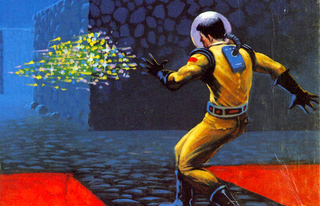
Game: Quest of the Space Beagle
Rating: D-
Remember Jupiter Mission 1999? Not too long ago (by my standards) I wrote up a review of the game and, generally, wasn't impressed; overall neat idea but the gameplay was too frustrating and boring. At the end of the story, however, our hero (the player) aboard the Space Beagle didn't make it back to Earth and is instead lost somewhere near a hostile, alien world. Now it's time to take a look at the sequel, Quest of the Space Beagle which picks up the story at this point. Like it's predecessor this game is made up of a series of action and strategy mini-games, although this time around there are fewer of them. Once again the results aren't spectacular; despite some improvements in the graphics and much more tolerable loading times, irritations abound making this title one that requires far more patience than I have to enjoy.
As mentioned, our story picks up right where Jupiter Mission left off; after destroying an alien tachyon device which could have led to an invasion of Earth, the Space Beagle has been zapped to a far away location: the home planet of the aliens who built the device! While one might expect aliens to be kind of annoyed that you just destroyed their tachyon device, it turns out these aliens aren't and are actually friendly. That doesn't help much though, as they still don't have a way to get you back to Earth and worse, they are being invaded by another hostile alien species! The device near Jupiter had been put in place as a sort of escape plan; if the war worsened, they would use it to abandon their home planet.
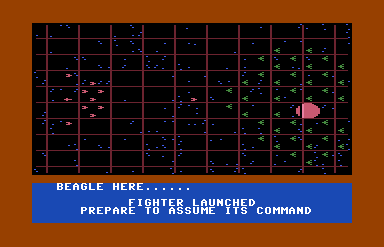
Due to all of this, our game begins with an action sequence! A fleet of 10 fighters has been sent to the attackers home world where an even larger fleet of 40 needs to be defeated. Players have a first person view as they control the fighters one at a time (if you have ever played any 80's space flight games such as Star Raiders you will be familiar with this view). Although the graphics flicker a lot (more on that at the end), the starfield simulation effects does look nice and the targeting/overlays and ship details are also quite good. Because this is a Jupiter Mission sequel, however, it follows the same modus operandi and really drags out the sequence without providing much that's interesting or varied. To complete this section of the game you'll fight two opponents at a time over and over again until all 40 are gone. Every enemy ship is the same with the same movements and attack patterns. There is no sense of progression other than seeing fewer ships on the overview screen should one of your ships be destroyed. It would have been nice if there was some variation here; different ships with different capabilities or attack patterns, a change of scenery, something; instead it's just repetition. The other oddity in this part of the game is the trick I found for actually destroying enemy fighters. Trying to chase them down doesen't work very well (they're too fast), but if you sit still miraculously they will mostly miss hitting you with their shots and will occasionally give you an opportunity to destroy them by wandering into your crosshairs all on their own. It does give an element of strategy to what would be an otherwise pure action sequence (how very Avalon Hill like!), but I found it counterintuitive. Oh well; overall, this first part of the game is fairly average. Technically it looks and sounds pretty good, but the repetition combined with the odd “strategy element” makes it duller than should be.
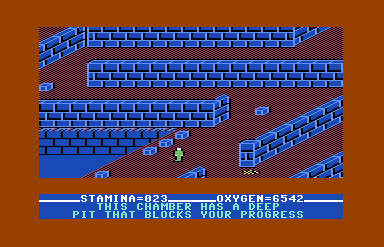
Ok, so after you defeat that entire fleet, you are made emperor of the planet (because of course you are). But...not until you survive the challenge of the Labyrinths of Kamerra! Continuing the Jupiter Mission style, this maze is large and you'll need to traverse back and forth several times in order to reach the end. This is due to needing to access computers to activate bridges that are initially missing. Be sure to map your progress as you go (unless you have an impressive ability to remember where you've been). This is one of those sections where there are a few differences between the Atari and Commodore versions; the maze itself and the graphics are the same (different colors aside), but there are some gameplay changes. In the Atari version, if you bump into a wall (or even bonus items) you'll lose some stamina and bounce backwards. While annoying, it's this in combination with another issue that makes it downright frustrating. There is no way to just nudge your character a small amount — he can only move in increments of the distance of a complete walk animation cycle. This makes avoiding walls pretty much impossible in some parts of the maze where there are numerous obstacles or the path is narrow. I wouldn't mind losing stamina for hitting a wall so much if control of the character was better, but as is you can get in a position where there's no choice but to ping-pong your way through an area and watch your stamina plumet. Very frustrating; luckilly, the Commodore version does not have this issue — running into a wall in this version does not reduce stamina and there is no bounce back when you do hit a wall which greatly improves the experience. For some reason though the Commodore version runs a lot slower! Our character moves along at a snails pace and the screen doesn't scroll as smoothly. So while the “fun” of bouncing around the maze has been improved you'll need more patience in this version as your character shuffles along and the oxygen level drops. No matter which version you play the maze ends up being quite tedious; avoiding walls and shuffling along both slow you down, and given the time limit (a.k.a. oxygen level) you'll likely need to try a few times before you can map out a path to the end. The last issue present in both versions is that while the walls look 3D, they don't act like it: you might expect your character could be at least partially obscurred behind a wall, but that doesn't happen. So while the walls look 3D they are really flat and touching any pixel of the wall registers as bumping into it. But at least the 3D effect of the wall mazes does look kinda neat for a BASIC game.
Once you escape the maze, you will have arrived at the most dull and annoying part of the game; finding a way home amongst all of the stars! You start the sequence at the super galactic level; the first goal is to locate the Local Cluster galaxies which contains the Milky Way, then from there locate the Milky Way itself, and finally locate the Sun within the Milky way. Supposedly all of the galaxies and stars are real ones and located approximately where they actually would be based on what was known when the game came out. Additionally, when you travel to different locations the star maps reflect what would be seen from that location. I can't confirm if that's true, but assuming it is it's a nice touch. A bunch of psuedo-science techno-babble provides the reason for this section of the game: although you have a hyperdrive in the Space Beagle now you can't quite just go about exploring willy-nilly. The hyperdrive is somewhat unstable and each time you jump from galaxy to galaxy or star to star you need to perform a hyperdrive rebalancing exercise to keep the Space Beagle on course. To do this, you'll see a grid consisting of 13 squares; a sequence of lights will flash in the squares, and you need to repeat the sequence back in a Simon / follow-the-leader fashion. Depending on the distance to your destination, you'll need to remember 4 to 9 locations to repeat. You'll need to do this at least twice for each hyperspace jump; if you get any responses wrong, you may need to do more and with too many wrong reponses you don't end up at your desired location but somewhere random in space.
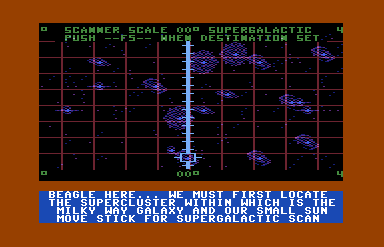
The memory game is the last part; complete that, and you've won! It's definitely not worth it. But, Quest of the Space Beagle does have a few plusses over Jupiter Mission 1999. Loading is less of an issue in this one; of course each section of the game needs to load, but compared to the seemingly constant disk access in Jupiter Mission it's a non-issue here. The graphics are a little nicer too; the 3D starfield effects look pretty good for the era, and the 3D effect in the maze sequence looks solid as well. Documentation is complete this time with no important gameplay elements hidden away in sealed “open only if you are stuck” envelopes. Sound is overall decent, although I prefer the Atari sounds over the Commodore — the game unfortunately didn't take full advantage of the SID chip and the sounds seem more muffled. But generally for a game written in BASIC it is technically pretty good. And, once again, artist Jim Talbot created a fantastic illustration for the packaging which captures the different game segments and makes the game look much better than it is.
But, about those graphics. While generally the graphics do look good, there is a lot of flicker in all but the maze sequence and some text screens in this game! The 60 Hz flicker is due to the game rapidly switching between two sets of graphics to give the illusion of more colors than were supported by the system and to add a sort of transparency-like effect to some graphics (essentially a form of temporal dithering). While the technique works, I find it annoying; the rate the game is able to perform the switch is too slow and, despite what the manual states, isn't something I got used to. In the Atari version, the game uses predominately dark colors to try to make the flicker less noticable. On real hardware I found the colors too dark and had to increase my tv's brightness to compensate. Your results may vary depending on the quality of tv you use or how well it's calibrated, but overall I think they overdid it with the dark colors here. Since the Commodore 64 has a palette strictly limited to just 16 colors total, darkness isn't an issue but the developers still went with the flicker technique even though the Commodore is (in some respects) more flexible with colors than the Atari. I think they should have left this trick aside and in the Atari version just gone with some more traditional techniques (sprites, display list interrupts) to improve colors and effects. It's not like this game used the flicker trick to gain a ton of extra colors anyway, so I don't know why decisions were made to use it; maybe made some aspect of programming easier or improved performance?
And that's pretty much it; I give this game a D-. While the first two sequences had their annoyances for sure, that final sequence with the having to memorize the light flash locations makes the game pretty much impossible for me and is why I gave this one a worse rating than Jupiter Mission 1999. Definitely not recommended. If you do wish to try this one and would like some tips and tricks, check out the walkthrough which provides a few hints for each section. Hard to believe, but it's New Year's Eve as I'm writing and this is the last news post/game review of 2025; perhaps I should make it a new years resolution to look at some better games next year? Either way, until next time take care!